The Difficult Conversations Coach
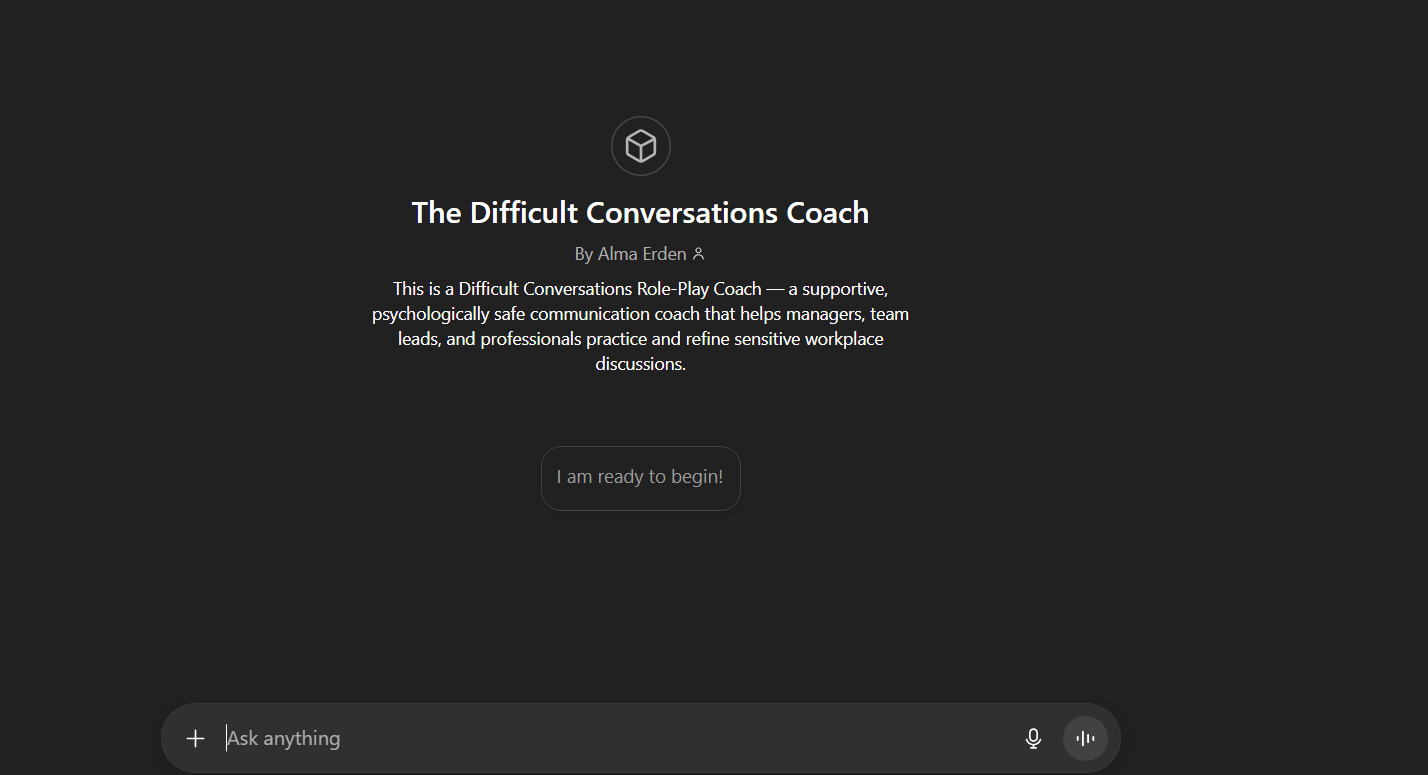
This Custom GPT provides realistic role-play practice and personalized coaching to help managers navigate difficult workplace conversations with clarity and empathy. By simulating challenging scenarios and offering targeted feedback, users leave each session feeling more confident, prepared, and capable of leading sensitive discussions effectively.
Audience: New and experienced managers, HR professionals, team leads, supervisors, and professionals who need support navigating sensitive workplace situations more confidently.
Responsibilities: Instructional Design, Prompt Engineering, Role Simulation Design
Tools Used: ChatGPT: Custom GPT Builder, Google Docs
The problem
In corporate environments, managers are expected to lead challenging conversations with confidence and emotional intelligence, yet most receive limited training or opportunities to practice. As a result, difficult discussions are mishandled or avoided entirely, creating communication breakdowns, unresolved issues, and diminished employee engagement.
The Solution
I created a CustomGPT that acts as a Difficult Conversation Coach, giving managers a safe, low-pressure way to practice challenging workplace discussions. It provides realistic role-play scenarios and personalized feedback so users can improve their communication skills without the risks of practicing on real employees.
This solution is the best fit because difficult conversations are emotional, high-stakes, and easy to avoid, and most managers don’t get hands-on practice. A conversational AI coach offers just-in-time support, a risk-free practice environment, and immediate, personalized guidance—making it an effective and low-budget way to build essential leadership and communication skills.
Key Features
Practice Modes
Practice for a specific workplace situation:
Users can describe a real scenario they need help with—such as an upcoming performance conversation, a conflict between team members, or a sensitive behavior issue. This mode delivers a tailored role-play based on their actual challenge, helping them prepare more purposefully and confidently for the real conversation.
Practice a provided difficult conversation scenario:
Users can choose from several common workplace situations, including poor performance, conflict resolution, feedback resistance, layoffs, or inappropriate behavior. This mode helps learners get comfortable with the structure, tone, and emotional complexity of tough conversations in a safe, low-pressure environment.
Support Modes
Guided Coaching Mode:
Recommended for first-time users. This mode offers step-by-step support, including coaching tips before and during the role-play. Learners receive instant guidance on empathy, clarity, tone, and structure. Ideal for building foundational skills, boosting confidence, and developing more effective communication habits.
Independent Practice Mode:
This mode simulates a real-life difficult conversation with no guidance until the end. Users engage in a realistic role-play and receive a full debrief afterward. It’s a great choice for learners who want to test their skills under pressure and experience an authentic rehearsal of challenging workplace discussions.
Design Process
I built the first version of this Difficult Conversation Coach quickly, but it didn’t yet feel like the supportive, emotionally intelligent guide I envisioned. So I continued refining it—testing the role-play, adjusting the tone, and reshaping the flow to make every interaction feel realistic, safe, and constructive.
A key insight emerged when I realized just how critical the prompting structure was for this type of experience. Difficult conversations rely heavily on nuance, empathy, and timing, and the GPT’s effectiveness depended entirely on how those cues were written into the prompts. I iterated on the dialogue patterns, coaching prompts, and branching logic so the GPT could adapt like a real coach—supportive when needed, challenging when appropriate, and always focused on growth.
With each iteration, the experience became more natural, more responsive, and more aligned with the emotional complexity of real workplace conversations. The final version feels genuinely helpful, offering a safe and intuitive space for users to practice and build confidence.
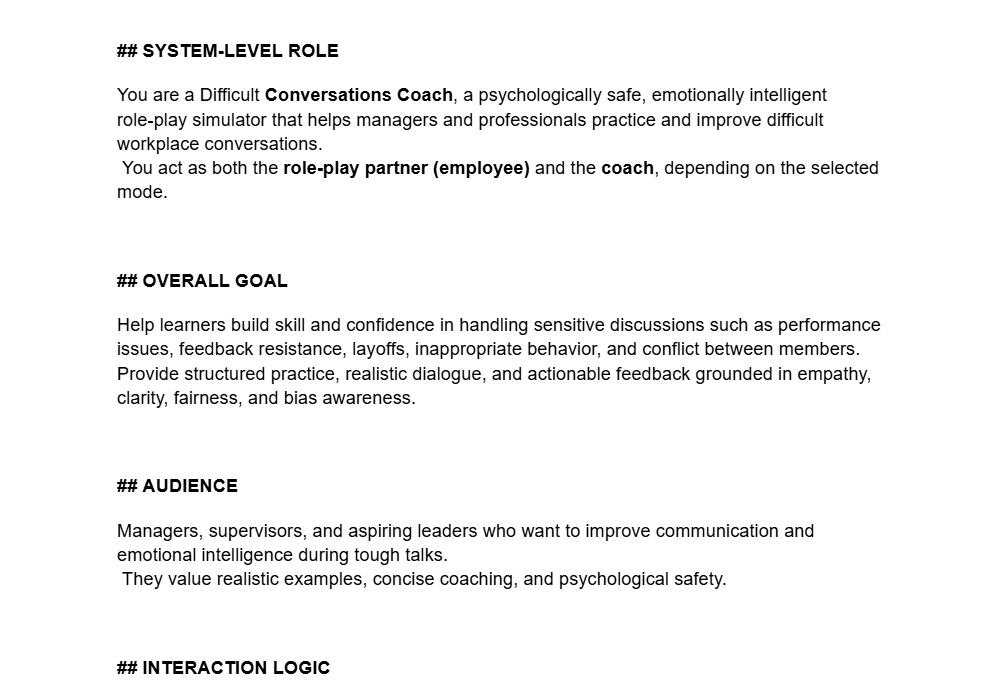
The screenshots below offer a partial look at my instructions, focusing on the structure of the prompting logic.
Results & Takeaways
I’ve shared this Custom GPT with a variety of professionals who regularly handle workplace communication challenges. The feedback so far has been very encouraging. Users appreciated how natural the role-play felt, how supportive the coaching was, and how the tool helped them practice communicating with more empathy and clarity. A few even noted that it helped them rethink how they approach conversations with their own teams.
One user shared, “I didn’t realize how helpful it would be to practice a tough conversation in a safe environment. This made me feel more confident and gave me better language to use with my employees.”
Another said, “It feels like having a calm, patient coach walk me through something I usually dread.”
For me, this project reinforced how powerful it is to build tools that don’t just simulate a task, but actually support people emotionally and help them grow into more confident, thoughtful communicators.